

Disclaimer: This review is an account of my personal experience with the AFERIY P210. It is not intended as a step-by-step instruction guide. If you are unsure about integrating any electrical equipment on your boat, please seek advice from a qualified marine electrician or professional.
Portable power stations seem to be everywhere at the moment, promising to replace noisy generators and tired old leisure batteries. But are they really the saviour of onboard power, or just another gimmick gadget destined to gather dust? I’ve been testing the AFERIY P210, a 2,048Wh LiFePO₄ unit with a 2,400W inverter, and here’s how it performed on my boat.
First Impressions
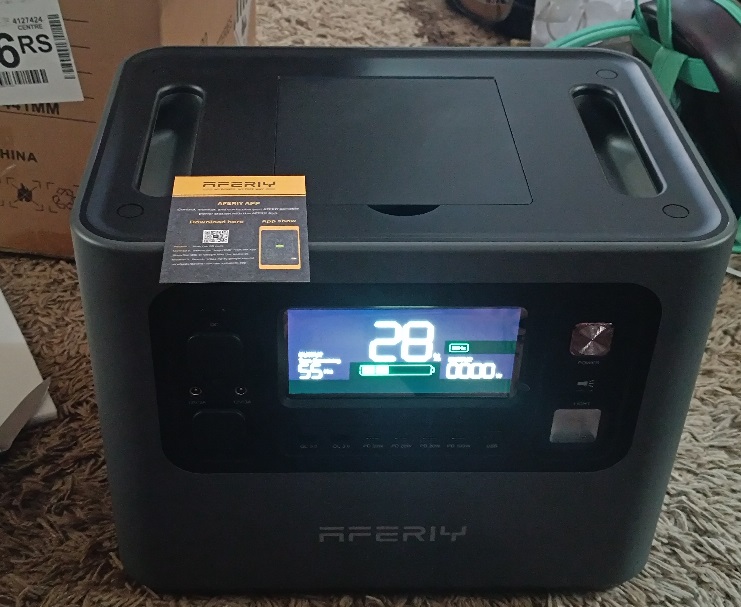
It’s big and heavy. At around 22kg, the “portable” label feels a bit questionable. That said, the exterior feels rugged and well-built, with moulded handles that make it easier to shift around (though you wouldn’t want to lug it too far).
The front panel is packed with outlets — AC, USB-A, USB-C, DC — so you don’t need a tangle of adapters. The display is bright and easy to read indoors, though it can be reflective in full sun on deck. This isn’t a unit to hide away in a locker; it’s a centrepiece of your power setup, and you’ll want it accessible.
Charging Options
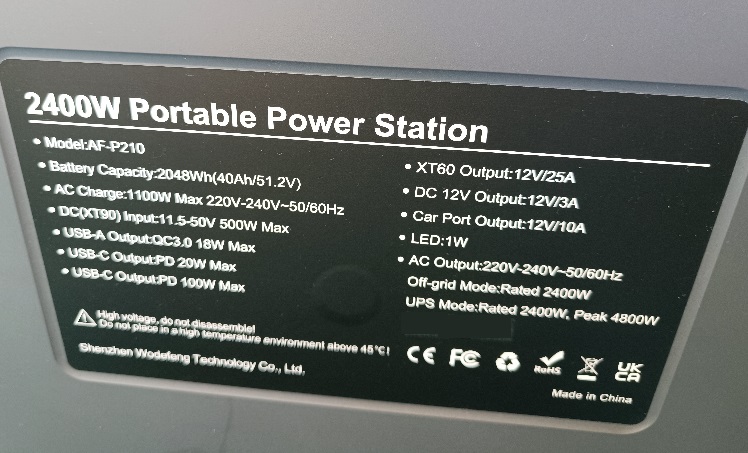
On shore power, the P210 charges surprisingly quickly — in my tests, from empty to full in just over two hours, close to the manufacturer’s claim. Through the Bluetooth app, you can adjust the 230V input current, which is handy in marinas with shore power limits (though it does extend charging time).
Solar charging is supported up to 500W, though in reality, even a 400–500W panel won’t quite hit the maximum. Still, it works well (see my separate review of portable solar panels here: Portable Solar for the Boat – Does It Work?).
Under heavier loads, the cooling fans kick in. They’re not jet-engine loud, but in a quiet cabin you’ll notice them. The unit itself warms up, but never beyond what the fans can manage. I tested it in the open air with plenty of ventilation — something to keep in mind if you plan to box it into a cupboard.
Why I Chose a Portable Power Station
My boat’s leisure batteries are nearly 15 years old and only hold a fraction of their original capacity. Replacing them with LiFePO₄ would have cost almost as much as the AFERIY unit, and I’d still need an inverter, wiring changes, and more.
With the P210, I saw the chance to add reliable storage, a powerful inverter, and flexible charging without ripping out my old system. It was almost the same cost as new batteries alone, but offered a lot more flexibility.
Powering the Boat
With its 2,048Wh LiFePO₄ battery and 2,400W inverter, the P210 is capable of far more than charging phones and tablets. I tested it in isolation first — plugged directly into shore power and running all my onboard chargers and appliances. It worked flawlessly.
The soft-start feature even powered the induction motor on my grinder when I had to cut through an outboard padlock (after losing the key in the water — not a good day). Pulling power through the water heater, air fryer, chargers, and more, I could draw up to around 2,350W. Beyond that (2,350–2,410W), the unit would trip and need a manual reset. For me, not a deal-breaker, but worth noting if you run high-load kit.
Used as a “top-up” for my ageing batteries, the P210 extended my endurance from 2 days to 5 days without running the engine or a noisy generator. A simple plug-and-play setup, no rewiring required.
Improvements I Later Made
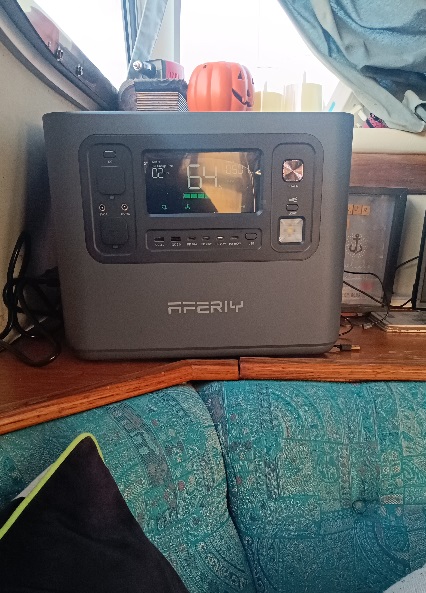
After a few weeks, I decided the P210 was becoming a permanent part of my boat’s power system. I built it into a cupboard with two vents for cooling, then added:
- A 12V to 13.8V DC-to-DC charger wired into my batteries via an XT60 plug on the AFERIY’s 12V outlet. This avoided inverter losses when charging my leisure batteries.
- A 230V shore power connection in the cupboard so the unit could plug in directly without trailing cables.
- A solar plug and engine plug wired via two programmable relays, allowing automatic charging from solar panels or when the engine is running.
It’s worth noting that when charging directly from the engine’s 12V output, the AFERIY limits input to 120W to protect wiring in cars, boats, and caravans. This can be bypassed with some tweaks — something I’ll cover in my next post when I walk through the DIY charging system.
One drawback I discovered: unlike some competitors, the P210 doesn’t offer a battery expansion port. If I ever want more capacity, I’d need to move to a different unit rather than adding extra packs.
Pros and Cons
| Pros | Cons |
|---|---|
| Big 2,048Wh LiFePO₄ battery with long cycle life | Heavy at 22kg — portable, but only just |
| 2,400W inverter handles real-world loads (grinders, kettles, chargers, etc.) | Display can be reflective in bright sunlight |
| Rugged build quality with integrated handles | Cooling fans are noticeable in a quiet cabin |
| Charges quickly on shore power (just over 2 hours in my tests) | Trips out between 2,350–2,410W and requires a manual reset |
| Adjustable 230V input via the app — handy for marinas with power limits | Limited to ~120W charging from 12V engine input (without modifications) |
| Bluetooth app lets you monitor status and adjust AC/DC outputs remotely | Takes up a fair bit of space — needs good ventilation |
| Flexible charging: shore power, solar (up to 500W), engine, or DC | No Battery bridge plug – you cannot increase the battery capacity |
| Clear display and plenty of output options (AC, USB-A, USB-C, DC) | |
| Simple plug-and-play integration with existing systems | |
| Portable — can be used on or off the boat | |
| One of the cheapest units in its class | |
| Combines multiple systems in one unit: batteries, inverter, solar PWM, and multiple DC outputs |
Final Verdict
So, is the AFERIY P210 a saviour or just another gimmick? For me, it’s definitely closer to the saviour end of the scale. It transformed my onboard power setup from limping along on ageing batteries to something far more flexible, reliable, and convenient — all without tearing apart my existing wiring.
It’s not flawless. The weight makes “portable” a bit of a stretch, the fans are noticeable in a quiet cabin, and the lack of an expansion option may be a deal-breaker for some. But as an all-in-one unit that combines battery storage, inverter, solar charging, and multiple outputs, it’s hard to beat at this price point.
If you’re in the same position I was — old batteries, limited space, and wanting more flexibility without a full rewire — the AFERIY P210 is a very practical solution. For me, it’s not a gimmick. It’s earned its place on board.